Revelation 17:5–8 — The Beast That Was, Is Not, and Is to Come
Thank you for joining me as we continue our verse-by-verse study through the book of Revelation. We are in chapter 17, and I want to begin by reminding you of a few comments from our last episode.
Revelation 17 is widely regarded as one of the most difficult chapters in Revelation, if not in all of Scripture. My goal is to lay out some of the different interpretations and explain why people hold them.
People have been discussing these verses for nearly 2,000 years—many of them much smarter than me. It is unlikely that we will suddenly discover all the answers in one short Bible study. What we can do is look closely at the text, consider the different interpretations, become more familiar with the options, and learn to be comfortable with some uncertainty.
That is one reason I decided to devote three episodes to this chapter.
Study Like the Bereans
As I mentioned in the previous lesson, I encourage you to follow the example of the Bereans. Acts 17:11 says:
“They received the word with all eagerness, examining the Scriptures daily to see if these things were so.”
The Bereans did not believe something merely because Paul told them. They examined the Scriptures for themselves to determine whether he was speaking the truth.
I ask you to do the same. Never believe something merely because you heard a preacher or Bible teacher say it. Listen carefully, but then search the Scriptures and do your own research to determine whether what you are hearing is true.
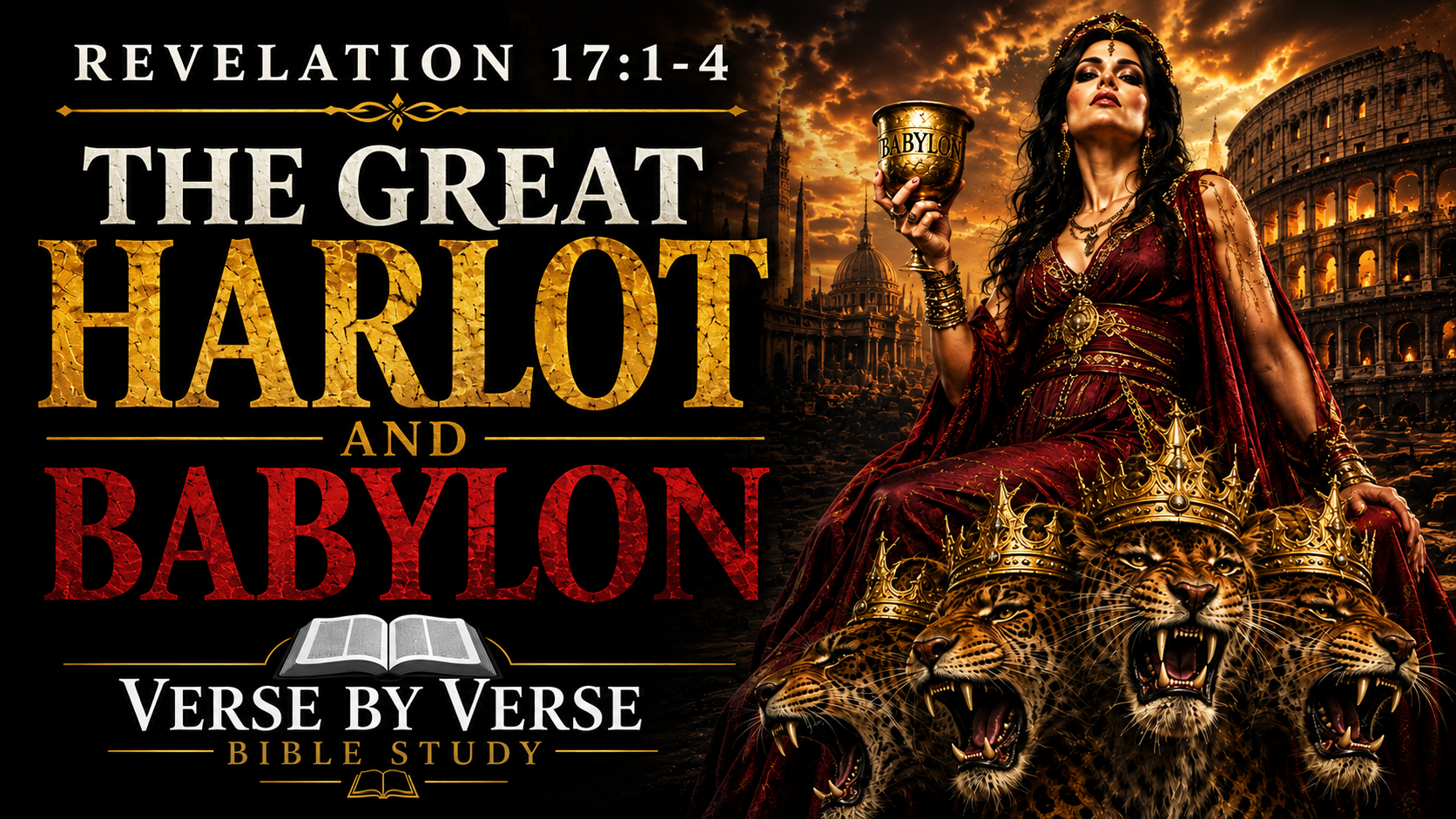
In our previous study of Revelation 17:1–4, we were introduced to the great prostitute—the mysterious woman John sees riding the scarlet beast. We considered several interpretations of whom or what she represents.
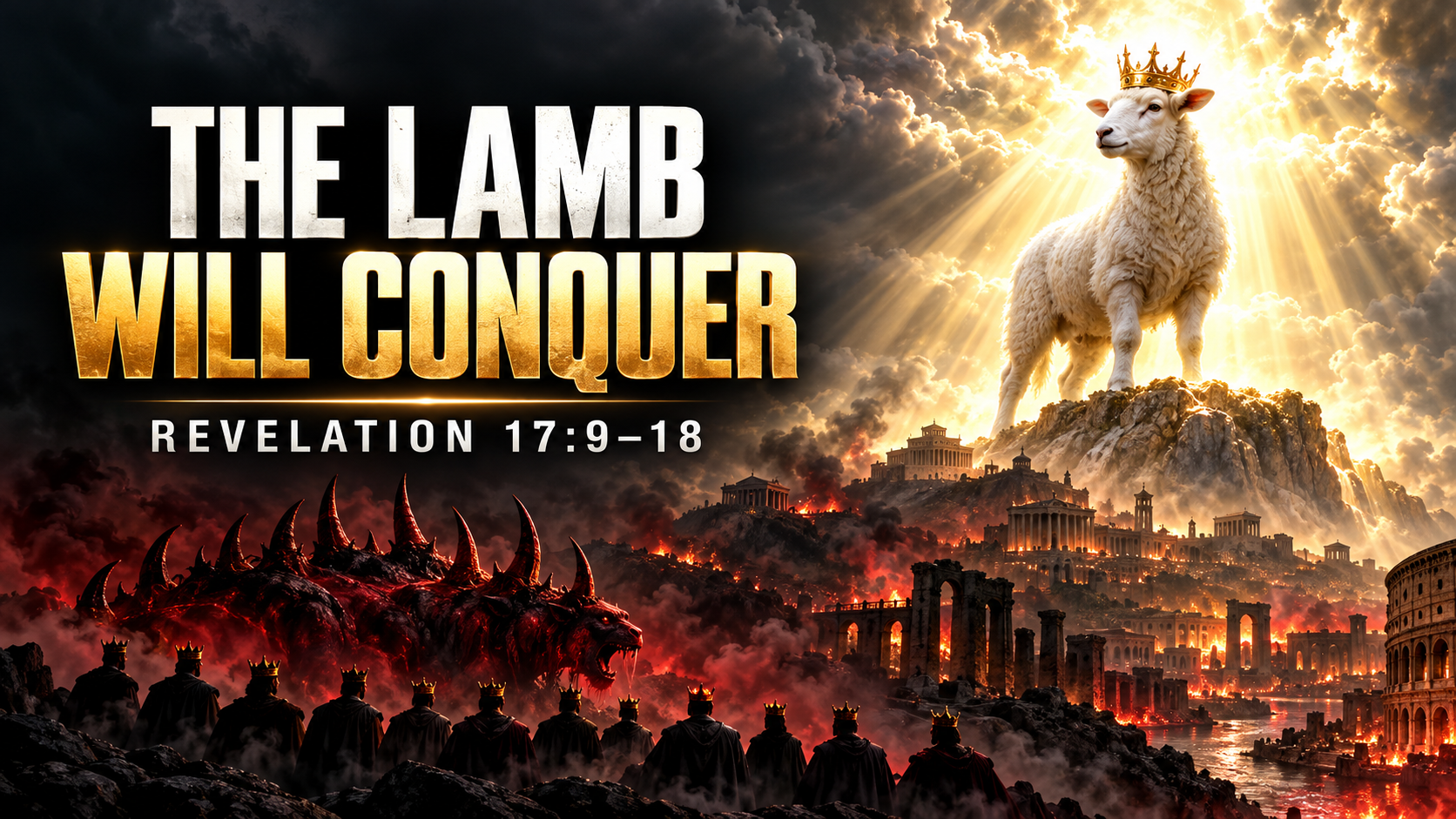
We also began unpacking the imagery of the beast’s seven heads and ten horns, which symbolize kings and kingdoms that ultimately unite in rebellion against God.
Regardless of what every detail symbolizes, kingdoms rise and kingdoms fall—but in the end, Jesus Christ remains.
Babylon the Great
Let’s continue with Revelation 17:5 and the first half of verse 6:
“And on her forehead was written a name of mystery: ‘Babylon the great, mother of prostitutes and of earth’s abominations.’ And I saw the woman, drunk with the blood of the saints, the blood of the martyrs of Jesus.”
The mystery of the woman is now disclosed. She has a name written on her forehead, just as those belonging to the beast have a name or mark on their foreheads.
In Revelation 13, speaking of the beast, John said:
“It causes all, both small and great, both rich and poor, both free and slave, to be marked on the right hand or the forehead.”
In Revelation 17, however, the woman does not merely have a mark on her forehead. She has a name.
Her name is called a mystery, meaning that her identity is not immediately apparent. Her true identity is obscured or hidden. Because unbelievers are not receptive to the Word of God, they may not recognize this woman for what she truly is.
We spent much of the previous episode discussing the woman’s possible identity. The majority view among scholars and theologians is that she represents Rome, or everything Rome stood for—from ancient Babylon to Rome and ultimately to the modern world: everything that opposes God and lives in rebellion against Him.
The name on her forehead reads:
“Babylon the great, mother of prostitutes and of earth’s abominations.”
The mystery is that Babylon continues to rise repeatedly as the city and world system that opposes God.
This reaches back to Genesis 11, where the people attempted to build the Tower of Babel in order to make a name for themselves rather than give glory to God.
The particular city is not ultimately the point. It could be ancient Babylon, imperial Rome, or a modern city or nation. The important question is what the city represents.
John calls the woman the mother of prostitutes and of the earth’s abominations. She is detestable because of her idolatry and moral corruption.
Babylon and Rome became patterns or prototypes of the wickedness that would follow. The description of Babylon as the mother of prostitutes and abominations may symbolize her children—all the future kingdoms, nations, and cities she has influenced.
Ancient Babylon continued through Rome, and the spirit of Babylon continues through every city, kingdom, and culture that adopts her idolatry and rebellion.
When Revelation speaks of prostitution in this context, it is not necessarily speaking about sexual sin. It primarily refers to spiritual unfaithfulness—idolatry and the worship of the creature rather than the Creator.
Babylon and Rome are the prototypes of a world in rebellion against God.
Drunk With the Blood of the Saints
The first half of Revelation 17:6 says that the woman is:
“Drunk with the blood of the saints, the blood of the martyrs of Jesus.”
Once again, we see that the harlot is not as beautiful as she initially appears. She is drunk with the blood of God’s people.
Christians were already being martyred for their faith during the first century, and Revelation 6 tells us that this persecution and martyrdom would continue.
Rome had become intoxicated with its own glory and power. It may have tolerated Christianity if believers had been willing simply to add Jesus to the Roman pantheon alongside its many other gods.
Christians could not do that.
Their confession that Jesus alone is Lord meant they could not worship the emperor as divine. That refusal placed them in direct conflict with the Roman state and led many believers to imprisonment, torture, and death.
This helps us understand John’s horrifying picture of the woman drunk with the blood of the saints and the martyrs of Jesus.
She is not merely guilty of isolated acts of violence. She has become intoxicated with persecution. The blood of faithful believers is pictured as the wine of her rebellion against God. She celebrates what should bring shame and treats the suffering of Christ’s people as evidence of her power.
Rome provides a vivid historical example of this spirit, but the vision should not necessarily be restricted to Rome.
The harlot represents the recurring pattern of worldly power—whether political, religious, economic, or cultural—that demands the allegiance belonging to God and turns against anyone who refuses to compromise.
Babylon and Rome may change their outward appearances from one age to another, but the demand remains the same:
Conform, bow down, and give the world what belongs to God.
The saints overcome this pressure not by overpowering Babylon but by remaining faithful to Jesus, even when faithfulness costs them everything.
Many Christians were executed under Roman emperors such as Nero. Some were publicly killed for the entertainment of Roman audiences. Others were condemned to arenas, where they were exposed to wild animals as crowds watched.
Under Nero, Christians were reportedly covered with flammable material, fastened to crosses or stakes, and set ablaze to illuminate his gardens at night. The persecution became so appalling that even some Romans who opposed Christianity became horrified and called for it to end.
The suffering and bloodshed of Christians became a public spectacle—an especially vivid illustration of the harlot drunk with the blood of the saints and martyrs of Jesus.
The Angel Explains the Mystery
Let’s continue with the second half of verse 6 through verse 8:
“When I saw her, I marveled greatly. But the angel said to me, ‘Why do you marvel? I will tell you the mystery of the woman, and of the beast with seven heads and ten horns that carries her. The beast that you saw was, and is not, and is about to rise from the bottomless pit and go to destruction. And the dwellers on earth whose names have not been written in the book of life from the foundation of the world will marvel to see the beast, because it was and is not and is to come.’”
When John sees the harlot, he is astonished by the sight of the woman drunk with the blood of the saints.
The angel asks him, “Why do you marvel?”
We should pay close attention to that question because the angel provides the heavenly perspective from which the woman and the beast must be understood.
The mystery centers on the relationship between the woman and the beast.
Revelation 17:3 said that the woman sat upon the beast. We are now told that the beast carries and supports her. In other words, the empire is responsible for her splendor and glory. Without the military and political power of the empire, the woman—symbolic of Babylon or Rome—is nothing.
The beast possesses seven heads and ten horns. Seven frequently symbolizes completeness or complete authority. The ten horns, as we will see in the next lesson, symbolize ten kings who exercise authority with the beast.
The seven heads and ten horns therefore portray the political and military strength that enables the beast to support the harlot.
The Beast Who Was, Is Not, and Is to Come
That brings us to Revelation 17:8, one of the most difficult verses in the entire book:
“The beast that you saw was, and is not, and is about to rise from the bottomless pit and go to destruction.”
There is no way I know of to determine with absolute certainty how every detail of this verse should be interpreted. There are several possible understandings.
If the wording sounds familiar, it should.
Throughout Revelation, God is described as the One “who is and who was and who is to come.” But the beast is described as one who “was, and is not, and is about to rise.”
It appears to be a deliberate counterfeit of God’s eternal existence.
The beast mimics God because Satan repeatedly counterfeits the things of God.
We have already encountered what appears to be a counterfeit trinity: the dragon, the beast, and the false prophet. We also saw in our study of Revelation 13 that the beast suffers what appears to be a mortal wound and then recovers.
The beast experiences a type of pseudo-resurrection, causing the world to marvel and follow him.
But this counterfeit resurrection is short-lived and followed by destruction.
Revelation 17:8 appears to describe the beast as both a satanic world empire and the final ruler who embodies that empire. The expression “was, and is not, and is to come” presents the beast as a blasphemous counterfeit of Christ.
God is described as the One who is, who was, and who is to come. He is the Alpha and the Omega.
The beast imitates that divine description—but he does so imperfectly:
- Jesus Christ was, is, and is to come.
- The beast was, is not, and will appear again—only to be destroyed.
The beast creates the appearance of resurrection and invincibility, but his return is only temporary. His destination is destruction.
As we discussed previously, the beast is probably more than one particular government. It should not necessarily be restricted to ancient Babylon or Rome. Those empires serve as archetypes.
The beast represents the recurring spirit of political power organized in opposition to God.
A Counterfeit Resurrection
The text says the beast “was” and “is not.” At some point, the beast appears to have been defeated or removed.
This connects naturally with Revelation 13:3, where one of the beast’s heads receives what appears to be a mortal wound but is later healed.
The people of the earth marvel because the beast appears to accomplish what only Jesus Christ truly accomplished: it returns from apparent death.
But this is a counterfeit resurrection.
Jesus rose to reign forever. The beast returns only briefly before going to destruction.
Consider what may become possible through artificial intelligence. In the near future, we may reach a point where viewers cannot distinguish an artificially generated video from authentic footage.
The world could conceivably watch what appears to be the assassination of a person and later see that person apparently return to life. Yet it could all be a manufactured deception—a cheap imitation of what Jesus Christ truly accomplished approximately 2,000 years ago.
The world may marvel and follow like sheep to the slaughter.
That is only one possibility, and we should be cautious about claiming certainty. But it illustrates how a counterfeit resurrection could potentially deceive the world.
A Revived Roman Empire?
Many dispensational interpreters believe the beast who “was, and is not, and is to come” refers to the ancient Roman Empire returning in a final form—possibly through a coalition of European nations.
The visions in Daniel 7 appear to connect the final kingdom with Rome in some way. However, identifying that kingdom specifically with the modern European Union remains speculative.
Revelation tells us that ten rulers will give their authority to the beast, but it never names the European Union or requires those rulers to correspond with its present membership.
Many interpreters continue watching Europe’s changing membership and political alliances, believing that ten nations may eventually form such a coalition. We will examine that interpretation more closely in the next episode.
Don’t Marvel—Remain Faithful
As we conclude with Revelation 17:8, I believe one of the primary lessons is this:
Do not be deceived by the splendor of Babylon, Rome, or any of their modern expressions. Do not be intimidated by the power of the beast.
The world may marvel at what Satan produces, but believers must learn to see it from heaven’s perspective.
It is counterfeit.
It is temporary.
And it is already destined for destruction.
Our calling is not to marvel, compromise, or bow down. Our calling is to remain faithful to Jesus Christ.
In his essay “Christianity and Culture,” C. S. Lewis wrote:
“There is no neutral ground in the universe: every square inch, every split second, is claimed by God and counterclaimed by Satan.”
Even though the beast may look powerful and his return may cause the world to marvel, Revelation tells us his destination before he ever arrives.
He does not rise to reign forever.
He rises only to meet his destruction.
That is the difference between the temporary power of the beast and the eternal power and authority of Jesus Christ.
You can find additional studies in the complete Revelation series or continue exploring the background of the beast in Revelation 13: The Antichrist and 666.