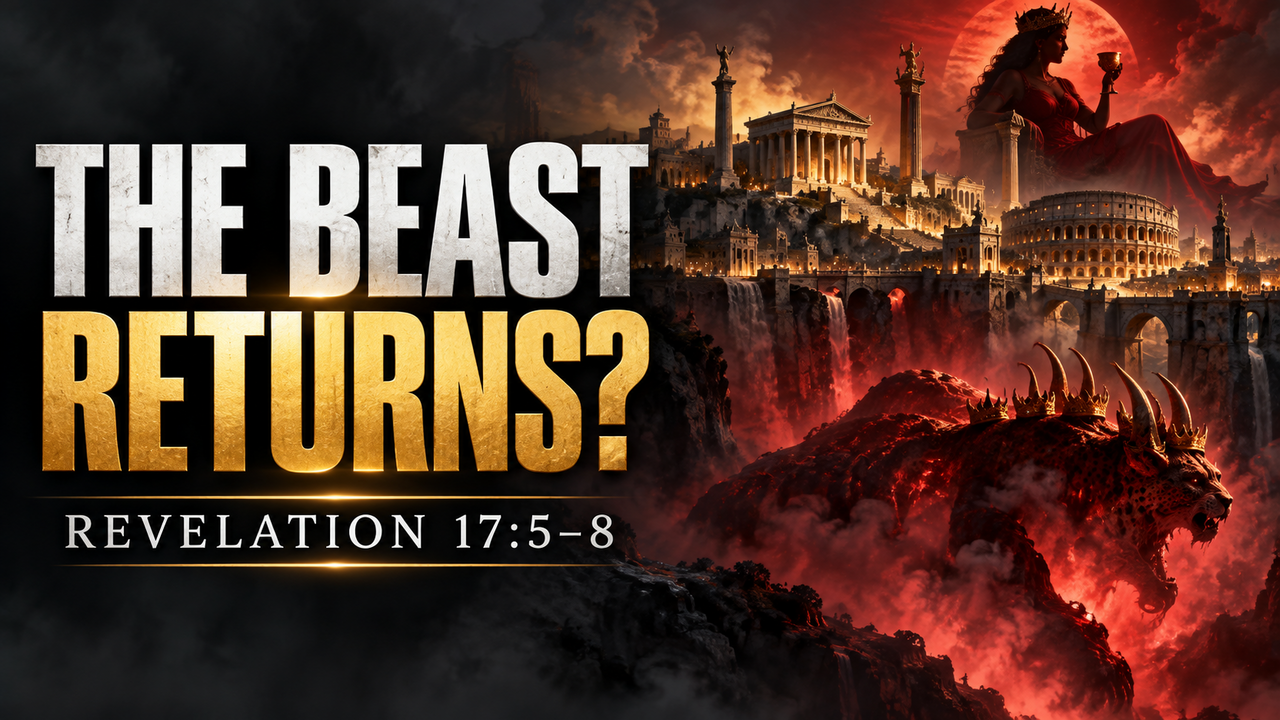
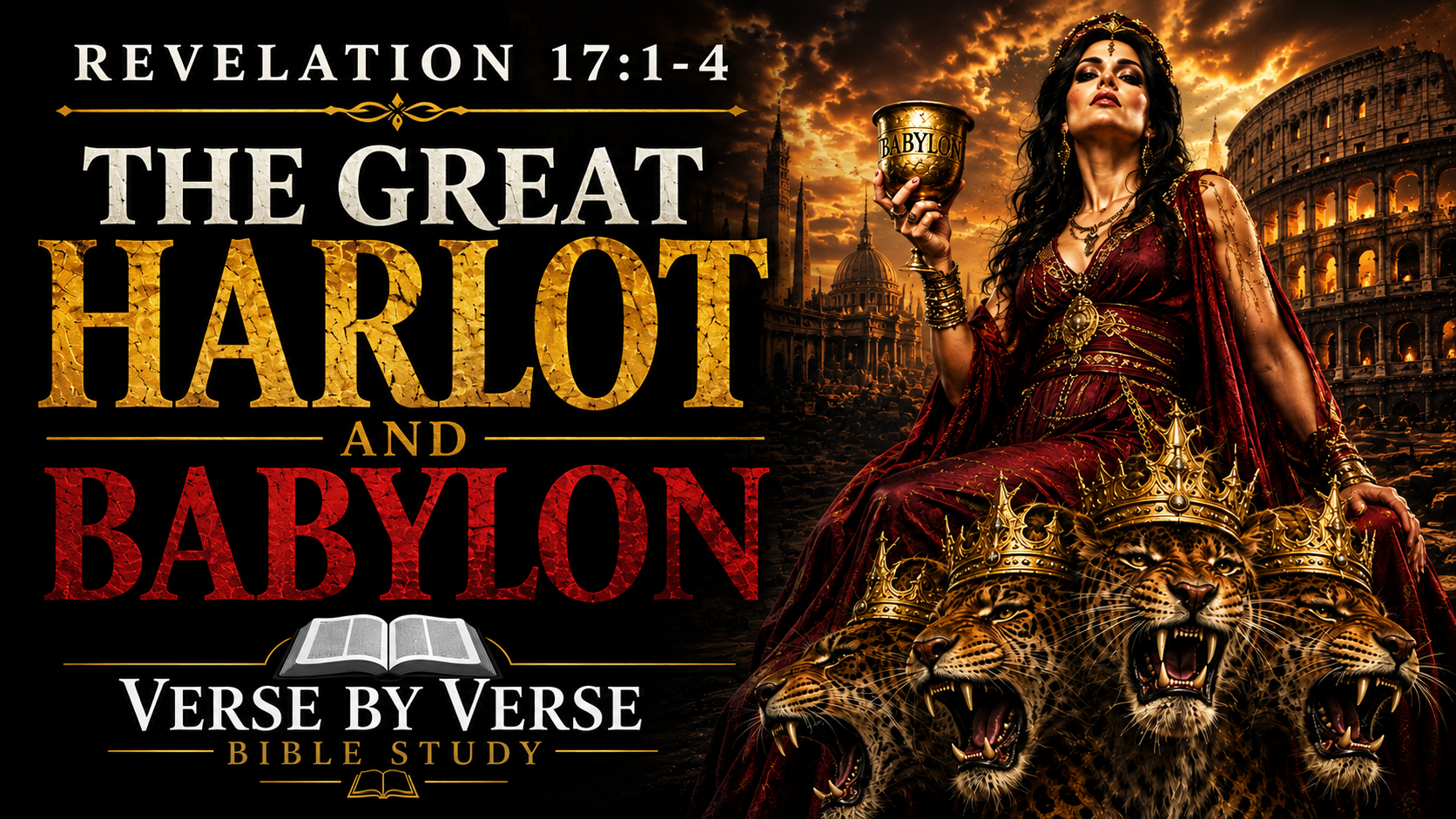
Well, thank you once again for joining as we continue in our study through the book of Revelation. We’re finishing up chapter 17, which has been one of the most difficult chapters of the book so far, if not in all of Scripture. In our last episode, we covered verses 5 through 8, where the woman, the great harlot or the great prostitute, is identified as Babylon the Great and described as being drunk with the blood of the saints. And we also considered the beast who was and is not and is to come, a counterfeit of Christ whose apparent return causes the world to marvel, but whose final destination is destruction.
And that we ended with the reminder that our calling is to not marvel at the beast, not to compromise, not to bow down, but to remain faithful to Christ, which brings us now to verses nine and ten, where the angel now explains the meaning of the seven heads and seven mountains.
Wisdom For Reading The Symbols
Beginning in verse nine, the angel tells John, This calls for a mind with wisdom. The seven heads are seven mountains on which the woman is seated. They are also seven kings, five of whom have fallen. One is, the other has not yet come, and when he does come, he must remain only for a little while.
So notice that the first thing the angel says here is that this calls for a mind with wisdom, meaning the angel is telling us that what follows, it requires more than just intelligence. It requires spiritual discernment. And so we need to look beneath the surface, allow scripture to interpret scripture and recognize this recurring pattern of worldly power that sets itself against God. Because the angel is about to interpret symbolism that can’t necessarily be understood simply by taking every image literally.
John’s readers must exercise spiritual discernment and allow scripture to interpret the vision. Now, this same expression appears in Revelation chapter 13 before the number 666. This calls for wisdom is what it says. And in both places, John warns us not to approach these symbols with sensationalism or some sort of a careless speculation.
But biblical wisdom asks not merely, can I identify every symbol? But also, can I recognize the spirit of Babylon when it appears, and yet still remain faithful to Christ? But the angel tells John, the seven heads are seven mountains on which the woman is seated. They are also seven kings.
And so this imagery, it has more than just one layer. The seven heads represent both seven mountains and seven kings. And so the vision, therefore, it combines geography, political power, and kingdoms. And in biblical imagery, mountains often represent kingdoms or ruling powers or places of spiritual authority.
And so the symbolism here reaches beyond mere geography. Babylon is seated upon the political and the spiritual powers of this world. Now we’ve already mentioned that many people believe these seven mountains represent Rome. As we already talked about, Rome was famously known as the city of Seven Hills.
And others believe, on the other hand, that we shouldn’t press the symbolism too hard, and that the seven here symbolizes complete power and authority. But I think it’s natural and it makes sense to assume that the readers in John’s day, they would have associated this harlot with Rome, and that Rome was simply a new manifestation of Babylon. And as we mentioned last time, Babylon is the mother of harlots and gave birth to Rome, and then Rome has given birth to her own children. And so Rome might be the city mentioned here, but the symbolism and the meaning, it transcends Rome, and it applies to all future cities that rebel against the things of God.
And in that vein, one thing that we may want to consider in the West, and especially here in America, is how exactly are we different from Rome? Augustine described human history as a conflict between two cities formed by two different loves, the earthly city formed by the love of self, and the heavenly city formed by the love of God. And maybe that is the dividing line running through Revelation 17 here, because Babylon says, glorify yourself. Jesus says, pick up your cross and follow me.
But when the angel here tells John that this requires wisdom, maybe wisdom means recognizing the pattern, because Rome may have been the immediate expression of Babylon, but it represents the larger recurring system of political and economic and religious power that is organized in rebellion against God. And so we know that the seven heads are seven mountains on which the woman is seated, and that they are also seven kings. But verse 10 continues by saying, Five of whom have fallen. One is, the other has not yet come, and when he does come, he must remain only a little while.
Seven Kings and Two Main Views
Now this verse has sparked a lot of speculation and controversy over the ages, and here we’re given more details about the seven kings that we just read about in verse nine, because of the seven kings, five have fallen, one is, and one is yet to come. And so of the seven kings, five of them have already fallen. And the Greek word used here for fallen is epesan, which comes from the Greek verb piptō, which means to fall or to collapse, to perish, to lose one’s position of power. And so in this context, five of whom have fallen, it indicates that the five kings or these five kingdoms had passed from power before John’s vision.
Now that word itself, it doesn’t specify exactly how they fell. They may have died, they may have been defeated, could have been overthrown, but the main point is that their reigns had ended. In other words, of the seven kings, five had been overthrown. Maybe they died or had passed from power, but their rule had ended.
And then we have the one king who is, which we assume means that this king was reigning when John wrote Revelation. And then finally, we have the one king which has not yet come. But when he does come, he will only remain on the scene for a short time. But the wording here with all of these seems to emphasize the temporary nature of earthly power.
These kings may have once appeared invincible, but by the time of John’s vision, five of them were already gone. And it should remind us again that kingdoms rise, but they eventually fall, while the kingdom of Jesus Christ will remain. Now I want to introduce you to a couple of different ways that these two verses are interpreted. One way is to view these seven kings as seven literal Roman emperors of the day.
The other way is to view these seven heads as seven successive kingdoms or empires. So let me first address the view that these are seven literal Roman emperors or rulers. But under this view, the seven heads are literally seven Roman rulers. Five emperors had died, one emperor was presently ruling, and one more would come and reign for a short time.
And then the beast would appear as an eighth ruler connected with those seven. Now a common starting point for these emperors begins with Julius Caesar, and they see Nero as the sixth, and so they name Julius Caesar, Augustus, Tiberius, Caligula, Claudius, Nero, who was seen as the king who is, and then Galba, who must remain only a little while. And Galba did rule for only about seven months, and so it does fit the phrase only a little while. This interpretation supports the view that Revelation was written during the reign of Nero before Jerusalem’s destruction in AD 70.
And the primary strength of this view is that John’s first readers would have naturally associated the seven mountains with Rome and the Seven Kings with Roman rulers. But its weakness is that the counting is disputed. Julius Caesar was not even technically an emperor, and there are all sorts of alternate starting points on where to begin counting emperors, which means each one of those produces a different list. Interpreters also disagree over whether the three short-lived emperors during Rome’s Civil War should even be counted.
And it seems like omitting any of the emperors, it just seems maybe a bit arbitrary, and many lists don’t even get us to Titus or Vespasian who actually destroyed the temple. And so needless to say, there’s a lot of debate which leaves a somewhat unclear picture, which is why some interpreters prefer to count empires rather than emperors. These empires are slightly different as well, but basically the empires are seen as Egypt, Assyria, Babylon, Persia, Greece, and those will be the first five, which have all fallen, and then Rome, which existed in John’s day, and then a future empire, which some believe will be a revived and reunited Roman Empire comprised of ten countries like we mentioned in the previous episode. Now these are not simply seven world empires just chosen at random.
They are the successive powers that dominated the world or persecuted God’s people. Five had passed away before John’s time. Rome held power in his day, and then there would be a final form of this beastly government remaining for the future. Now the strength of this interpretation is that the beast does appear to represent something larger than just one emperor or even one city.
It’s a recurring political system opposing God throughout history, and it also fits Revelation 17, 11, which we’ll discuss here in a moment. But its weakness is that Revelation never explicitly gives the names of these seven kingdoms. And maybe this is where that wisdom is needed that the angel mentions.
The Eighth King And Nero Echoes
But let’s continue with verse 11 where the angel continues explaining to John as for the beast that was and is not. It is an eighth, but it belongs to the seven, and it goes to destruction. Now this verse eleven, it sounds a bit paradoxical. I mean, how can the beast be an eighth king while also belonging to the seven?
And the point seems to be that the beast represents something new and final, yet it’s not truly new. It’s the culmination or the reappearance of the same anti-God power already embodied in the previous seven. Now the Greek phrase that’s translated “belongs to the seven” is ek tōn hepta, literally from the seven or of the seven. In other words, the eighth ruler emerges from the same succession from the same line, and it shares their character and embodies everything that they represented.
Now, under the Roman Emperor interpretation, the beast may represent a returning or revived form of one of the earlier emperors, most commonly thought to be Nero. Now John would not necessarily be predicting Nero’s literal bodily resurrection, but the final persecuting ruler could resemble Nero so strongly that Nero’s ungodly and persecuting spirit appears to have returned. But under the kingdom’s or empires interpretation, if the seven kings represent successive empires, the eighth represents the final kingdom and its ruler, the ultimate manifestation of the beast, what we might refer to as the Antichrist. It is of the seven because it inherits and it combines the characteristics of all the earlier kingdoms, their idolatry, their violence, their pride, their persecution of God’s people and the demand for worship and allegiance.
And so the final beastly kingdom is therefore an eighth expression of power, but it’s made from the same spiritual makeup as the seven that preceded it. Babylon, Persia, Greece, and Rome, they may fall, but their rebellious character reappears in the final empire. And this is the final embodiment of all of those previous kingdoms. And so the eighth king is new in appearance, but it’s ancient in character.
He is the final embodiment of the same rebellious power that worked through the kingdoms which existed before him. And before Revelation tells us exactly where he comes from, it tells us where he’s going, which is to destruction.
Ten Horns And A Brief Hour
But the angel continues in verses 12 and 13 by saying, And the ten horns that you saw are ten kings who have not yet received royal power, but they are to receive authority as kings for one hour, together with the beast. These are of one mind, and they hand over their power and authority to the beast. The angel now identifies the beast’s ten horns as ten kings. Unlike the seven kings of verses nine through eleven, these rulers don’t appear to represent a long historical succession.
They rise together at the end and exercise authority alongside the beast. This is one reason that many interpreters believe that the verse cannot refer exclusively to first century Roman emperors. The ten rulers belong to a later stage of the beast’s activity when multiple political powers unite under one central ruler. And so this image may therefore describe either a literal coalition of ten rulers or nations, or a complete alliance of worldly governments united behind the beast.
And they are of one mind, one purpose and one intention. And because of their unity, they will join an alliance to and give their power wholly to the beast. Now the Greek expression is mian hōran, which means one hour. And it probably doesn’t mean exactly 60 minutes.
It probably represents an extremely brief, divinely limited period of time. And so their power will appear impressive, but it will be short-lived. Just as the seventh king remains only a little while, these ten rulers receive authority for only one hour. And so the repeated message is that God limits both the extent and the duration of evil’s authority.
Now, some dispensational interpreters, meaning those who view biblical history as this series of distinct periods or dispensations, where God administers his purposes in different ways and he deals differently with Israel and the church. But the dispensationalists, they identify this with a revived Roman Empire or a future European coalition. And that is possible, specifically because Daniel’s fourth kingdom is commonly identified as Rome. But Revelation never names Europe, never names the European Union, and so making that identification with certainty, it just simply goes beyond what the text actually says.
And in fact, the Ten Horns, it may also be another way of symbolizing all the kings of the earth. Maybe it is all, or even most of the countries who unite with the beast. Maybe it’s something like the United Nations, maybe NATO, or some other one world order. But either way, the Ten Horns represent rulers who unite their authority behind the beast, and their coalition may appear powerful, but revelation tells us that it’s only for a short period of time.
The alliance of the beast will be formidable, but it’ll also be temporary because even the beast’s authority remains under God’s sovereign limit.
War On The Lamb And Certain Victory
But we then come to an interesting verse, verse 14, which reads, They will make war on the lamb, and the lamb will conquer them, for he is Lord of lords and king of kings, and those with him are called and chosen and faithful. And so we see that these kings who form an alliance with the beast conduct war with the lamb. And this is probably the war that we discussed earlier, the Battle of Armageddon. And we’ll also see this war described in chapter 19 when we get there, where we see Jesus on a white horse coming to destroy his enemies, which include the beast and the kings and their armies.
And as we read here and in other places in Revelation, the outcome of the war is never in doubt. The Lamb will conquer them because he alone is king. The kings may decide to wage war, but they don’t determine the outcome. And those who remain in Christ are described as called and chosen and faithful, and they will share in his victory.
Now the Greek verb describing this victory is nikēsei, meaning he will conquer or overcome or be victorious. And it’s related to the same word that’s repeatedly used when Revelation calls believers to conquer or to overcome. Just a side note, but something interesting. There’s an American company that took its name from Nikē, the Greek goddess and personification of victory.
And this is the same Greek root from a word associated with victory. But the company anglicized the word and rather than using the Greek pronunciation nikēsei, uses the anglicized pronunciation Nike. But in Revelation 17, the ultimate victory belongs not to Rome, not to Babylon or the beast, but to Jesus. And I would also add that many skeptics, many non-believers, they try to argue that Jesus isn’t God.
But here we see that Jesus is called Lord of Lords and King of kings. And that phrase makes a powerful statement about the divinity of Jesus. In Deuteronomy 10:17, God is called God of gods and Lord of Lords. And here, Revelation applies that same divine title to Jesus.
The Prostitute Turned On and Burned
But let’s continue with verses 15 and 16 where we read, And the angel said to me, The waters that you saw, where the prostitute is seated, are peoples and multitudes and nations and languages, and the ten horns that you saw, they and the beast will hate the prostitute. They will make her desolate and naked, and devour her flesh and burn her up with fire. Now, if you remember, verse one told us that the harlot sat upon many waters, and here in verse 15, that symbolism is now explained. The waters upon which the harlot is seated are peoples and multitudes and nations and languages.
Now John has already told us that the harlot is sitting on the beast, that it’s the beast which carries or supports her. And so when we look at the overall picture here, we see that the harlot sits upon the beast and the people. She is supported by the empire, the kings, and the general population of its citizens. And so the prostitute is therefore not merely one ancient city.
She represents a seductive, corrupt system whose religious and economic and cultural influence crosses national boundaries. This is worldwide. And so things seem good for the harlot until we read verse 16, which tells us that the ten horns that you saw, they and the beast will hate the prostitute. They will make her desolate and naked and devour her flesh and burn her up with fire.
And so it sounds like the honeymoon is over. But we’ve already mentioned that the beast and the ten kings will form an alliance and will turn against the harlot. They will hate her. Maybe they begin to realize that the harlot thinks that she’s in control rather than just a figurehead or a system.
And so we see this dramatic reversal here. The ten horns and the beast eventually turn against the prostitute who they once supported. They strip her naked, they devour her flesh and burn her with fire. And this is vivid language of complete exposure and humiliation and destruction.
And when we look back at the Old Testament in Ezekiel, we have examples of this similar type language, because Israel at times played the harlot, committing idolatry and following false idols, and God promised that because of her harlotry she would be left naked and shamed. And Ezekiel predicted that Jerusalem would be stripped and hated, so that it would be naked and ashamed. This is symbolic language indicating that the city would be destroyed, and indeed the Babylonians carried that out when they sieged Jerusalem and burned the temple. And ironically, Babylon, representing the final expression of spiritual adultery here, will be destroyed as well.
And it will occur as the beast and the ten kings turn against her. The alliance has ended. And the central irony here is that Babylon believes she controls the beast, but political power is never truly loyal to her. Their relationship exists only while it’s mutually beneficial.
But once the beast no longer needs her, it destroys her. Maybe because the Antichrist will no longer tolerate competition for worship or allegiance. And this works whether Babylon is understood primarily as Babylon or Rome, our modern world, an apostate religious system, a corrupt economic and cultural order, or some other final end times expression. It doesn’t matter.
The lesson is the same. The powers of this world may cooperate in rebellion against God, but they can’t remain united, because evil ultimately turns upon itself, and God can even use one wicked power to bring judgment upon another. And so what we see here is that Babylon appears to ride the beast, but she never truly controls it. The world’s alliances last only as long as they’re useful, but in the end, evil devours its own.
I mean, the relationship between the harlot and the kings and the beast, it’s not like Robin Hood and his merry men, it’s not like some band of brothers all happy and working together. Evil can bring people together around a common enemy, but it cannot give them genuine love or trust or loyalty. Just like Judas, he served the religious leaders, but once he was no longer useful to them, they abandoned him. And so, yes, evil can form alliances, but it cannot create genuine unity.
People who are united only by pride, by fear or hatred, they’re eventually going to turn that pride and that fear and that hatred upon one another, because evil cannot produce the love necessary to hold a kingdom together. And history repeatedly shows us, just like the Nazi Soviet pact, that alliances built upon those selfish ambitions, they eventually collapse. And Jesus said in Matthew 12:25, every kingdom divided against itself is brought to desolation, and every city or house divided against itself shall not stand. And here we see exactly that.
Babylon and the beast unite against God, but their alliance ends with evil turning upon and then devouring its own.
God’s Purpose Above Political Chaos
But let’s wrap up chapter 17 with the last two verses, which, after telling us that the beast and the kings will devour the harlot, continues by saying, For God has put it into their hearts to carry out his purpose by being of one mind and handing over their royal power to the beast until the words of God are fulfilled. And the woman that you saw is the great city that has dominion over the kings of the earth. And so we’re given a little more insight into the downfall and destruction of the harlot here. We know that the beast and the ten kings have turned against her, but now we’re given a sort of a peek behind the curtain in that God has put it into their hearts to turn against her in order to carry out his purpose.
And that’s quite a sobering thought, that even the hatred and destructive choices of these kings were being directed within God’s sovereign purpose. Now that doesn’t mean that God created their wicked desires, but he sovereignly directed their freely chosen actions so that even in their rebellion, it ultimately served his purpose. And so, even with what appears to be political and societal chaos happening and evil turning upon itself, it’s still taking place under the sovereign authority of God. And again, this doesn’t mean God makes these rulers morally evil or approves of their rebellion.
They willingly pursue their own corrupt and evil ambitions, but God uses their choices to accomplish his judgment. And so, much like Pharaoh, Assyria, or Babylon in the Old Testament, wicked rulers intend one thing while God sovereignly uses their actions for another. And that’s why that phrase, until the words of God are fulfilled, is important here. The beast’s authority has an expiration date.
These kings may believe that they’re establishing their own kingdom, but they unknowingly help fulfill God’s prophetic purposes. In Isaiah 46:9–11, we read, I am God, and there is no other. I am God, and there is none like me, declaring the end from the beginning, and from ancient times things not yet done. My counsel shall stand, and I will accomplish all my purpose.
I have spoken, and I will bring it to pass, I have purposed, and I will do it. And so the beast and the kings carry out the desires of their heart, but God already knows what will be fulfilled. Now the last verse of this chapter identifies the woman for us. She’s the great city that has dominion over the kings of the earth, and we’ve already discussed this.
This great city is Babylon or Rome, but not limited to those two cities. They’re the models, they’re the archetype, they’re the prototype. They represent the entire seductive world system, political, economic, cultural, religious, anything that uses wealth and power to draw humanity away from God. Rome was its first-century expression, but this final end-times Babylon will be its fullest expression and, as we’ll see, will then usher in the collapse of civilization.
Babylon Defined and Final Exhortation
And so as we end this very difficult chapter, I will leave you with this. The kingdoms of this world may appear powerful. Babylon may seduce the nations, and the beast may seem unstoppable, but none of them holds the pen that writes the final chapter.
Their alliances will collapse, evil will turn against itself, and every rebellious kingdom will fall. The beast may be given one brief hour, but Christ reigns forever. And because he is Lord of Lords and King of Kings, all of us who truly belong to Jesus will share in his victory.
Continue studying Revelation 17: Read Revelation 17:1–4: The Great Prostitute and Revelation 17:5–8: The Beast That Was, Is Not, and Is to Come.
Browse more episodes in the Verse-by-Verse Bible Study Podcast.